Metric rules: the concepts
Every kind of metric logic in Tattva in one place, with where it comes from, where you see it, who changes it, how it is checked, how answers use it and what a rebuild does to it.
Tattva's picture of your metrics is built from a dozen kinds of pieces: column profiles and meanings, generated formula metrics, the stored definitions you write, their inputs, settlements, filters, families, value groupings, relationships and conventions. This page lists them all in one place. For each one it says where it comes from, where you see it, who can change it, how it is checked, how answers use it, and what a rebuild does to it. It also covers what each kind of source can contain, which rule wins when two pieces disagree, and the states a stored definition goes through. The other pages in this section go deeper on each piece. To see all of them work together on one metric, read One metric, end to end.
The pieces
"Anyone with project access" means any member who can open the project. "Ontology Admin+" means the Ontology Admin, admin or owner role.
| Piece | What it is | Comes from | Where you see it | Who can change it | How it is checked | How answers use it | On rebuild |
|---|---|---|---|---|---|---|---|
| Column profile | Row, null and distinct counts; the 20 most common values of text columns with at most 1,000 distinct values | Build (Table Profiling) | Ontology › Manage › Knowledge Graph › source node › Schema: "≈N distinct", "common: …" | Nobody edits it; mark a column pii to stop common values | Personal-data names, pii/restricted and policy-tagged columns get no common values | Common values become clickable choices when an input is missing | Files: every build. BigQuery: when older than 7 days or the source has a new version |
| Column meaning and role | Meaning, role, unit, sensitivity, aggregation hint, temporal role | Build (About-Fields), then you | Sources › source › Schema; Make › Data › Data › Fields; Knowledge Graph drawer › Schema › Override | Anyone with project access, on a source the project owns; a shared source takes a project override | The Effect: line; no aggregation stops metrics summing the column | Guides metric generation and the agent's own SQL; an excluded column is refused in the agent's SQL (see Sensitive data) | Your edits are kept. They take effect only after a build ("curation edits saved but not yet in effect") |
| Formula metric | An aggregation over columns, such as SUM(item_revenue_inc_tax) | Build (Metric Generation), or + Add metric | Make › Data › Domain (chip Formula); Make › Data › Data › Metrics | Edit: anyone with project access. Delete: Ontology Admin+ | Self-Test raises Formulas conflicts (no formula, division without NULLIF, unknown columns) | Compiled by code with its filters and verified many-to-one joins only | Proposed again each build. Below 85% confidence it goes to Review. A formula you edited is not overwritten; one you deleted is not recreated |
| Stored definition | Your SQL, kept whole, with inputs as @name | Your document, via Rules Extraction, accepted in Review | Domain row (chip Stored query or Drafted from prose); drawer › Definition | Changed only by accepting a replacement from a new document. Anyone with project access can accept a document card | V1–V12 at review; a dry run at every build | Run as written by code before the model writes; the model does not rewrite it | Never changed by a build. If it stops compiling, the build raises "Stored definition of x no longer runs" |
| Input (parameter) | A value in the query that changes with the question | Your document: the literal it replaced | Parameters table on the review card and the Definition tab; "Inputs:" on the row | Only through a replacement document | V2 (declared and used), V6 (same result), V11 (lists on grouped columns), V12 (derived dates) | Bound by code for each question (see below) | Unchanged |
| Settlement | Days after which a metric's figures stop changing | Your document ("RTO takes 21 days to show up") | "Settles after N days — …" on the row; chip settles after N days | Set: through Review. Retire: Ontology Admin+ with Retire | V2 needs it for inputs dated from the unsettled days; V12 checks those dates | Marks a figure Provisional from the first unsettled day | Unchanged |
| Filter | A row exclusion bound to a formula metric | Your document | A reusable filter card; a filter · when … box on the row | Set: through Review. Retire rule: Ontology Admin+ | V8 checks that a metric built from this one applies it | Applied when code compiles a formula metric. Never applied to a stored definition | Unchanged |
| Family and variant policy | One word ("revenue") covering several metrics, and what to do when nobody says which | Your document | Family group row on Make › Data › Domain; Variant of chips; metric family card | Policy: Ontology Admin+ with [change]. Membership: through Review | F1–F5 at review; each build flags families that lost a variant or their default | Show all variants, ask which one, or use a default and mention the others with their figures | Unchanged |
| Value grouping | Raw spellings grouped under one label | You | Knowledge Graph › source node › Schema › Values; "N mapped" | Ontology Admin+ | V11 warns when a definition compares a grouped column with = | A label in the question is widened to every raw value in it, through a list input | Unchanged. Builds may raise a Data Quality conflict for values that do not match |
| Relationship (join) | How two tables join, with its keys and direction | Build (Relationship Inference), or + New relationship | Ontology › Manage › Knowledge Graph: edges and the edge drawer; Open link → on a conflict | Join keys and + New relationship: anyone with project access, on this project's edges. Delete and Mark verified: Ontology Admin+. Workspace edges: Ontology Admin+ | Verified by the build only when at least half of the smaller column's values meet the other column and one of the two columns holds each value once; no shared values and it is not created; both columns repeating their values (many-to-many) and it is not proposed, "would multiply rows". Modelling findings flag verified joins that cannot run or share no values; the drawer shows each key pair's measured value overlap | Formula metrics join only along verified many-to-one links; stored definitions use their own SQL joins. Joins with no shared values are not given to the agent | Measured again each build: unverified ones go to Review, and a link that stops measuring as verified, or now measures as many-to-many, loses verified. With Link proposals set to Send to Review, all go to Review; with Off, none are inferred. A deleted edge, or a rejected link card, is not re-inferred in either direction; join keys set by a person, and Mark verified, are kept |
| Convention | A reading rule such as currency, date format or time grain | Build (Domain Enrichment) | Make › Data › Data › Detected Conventions | Edit: anyone with project access. Delete: Ontology Admin+ | Shown with a confidence | Given to the agent as context for every question | A value you edited is not overwritten; one you deleted is not re-added |
Scope (convention category domain_scope) | What the data covers, for example "D2C website orders only" | Seeded, or you add it as a convention with category Scope | Make › Data › Data › Detected Conventions | As other conventions | — | Shown as a Scope line under every answer; a question clearly outside it gets a short refusal instead of an answer | As other conventions |
Not answered yet (convention category not_ready) | A topic the team does not answer yet, with the reason users see (name = the topic, value = the reason) | You add it as a convention with category Not answered yet | Make › Data › Data › Detected Conventions; What you can ask on Reasoning; the configuration document | As other conventions | — | A question about the topic gets the reason and example questions instead of an answer, and is listed under Feedback › Asked but not answered | As other conventions |
| Available from | The first date a metric's figures are valid from | You, on the metric's Definition tab (suggested from the earliest date in the data) | Definition tab; the metric's page in the configuration document | Ontology Admin+ | — | The part of a requested period before the date is not answered for that metric ("not available before …"); the rest is | Unchanged |
Where each input's value comes from
| Kind of input | In your query it was | Shown as ("Value comes from") | Filled in by |
|---|---|---|---|
| Period start | The first date of the reporting period | from the question's period (start) | The question's period |
| Period end | The date after the period's last day | from the question's period (end) | The question's period |
| Derived date | A date a fixed number of days from the period, from the first unsettled day, or from today | the day after the period + 90 days; filled in by code: tail start − 30 days | Code, never asked |
| Dimension | A value you said changes with the question, such as a warehouse list | from the question | A value or grouped label named in the question, otherwise asked |
| User | A value the person asking gives, such as the number of days in a repeat window | asked from the user | A value the question states ("66 day"); otherwise the definition's default, if it has one; otherwise the user, through Needs clarification |
| Default | A value used when nothing else supplies one | "(default …)" after the source | The definition |
Details and the clarification card: Inputs and groupings.
What a source can contain
| Source | Types | What Tattva does with it |
|---|---|---|
| BigQuery table | Any table the workspace's BigQuery identity can read | Queried where it lives, never copied. Profiled, described, and used by formula metrics, stored definitions and the agent's own SQL. Stored definitions run only on BigQuery. |
| Uploaded file | .csv, .tsv, .xlsx, .xls | Parsed into a table, profiled and described. Used by formula metrics and the agent's own SQL, never by a stored definition, and never joined with a BigQuery table. |
| Metric document | .md, .txt | Kept word for word. Read by the next build's Rules Extraction, once. |
What a metric document's sections become:
| A section that… | Becomes | Card type in Review |
|---|---|---|
| Defines a metric with a query, SQL pieces or prose | A stored definition with inputs | metric definition |
| Says one word covers several metrics | A family with a policy | metric family |
| Says a metric settles after N days | Folded into that metric's definition when the same document defines it; otherwise its own card | settlement window |
| Excludes rows ("never count cancelled items"), including an exclusion sentence inside a metric's own section ("It leaves out items cancelled on the panel") | A filter, for formula metrics. From inside a metric section it often has no Applies to. Reject it when the exclusion is already in that metric's stored query. | reusable filter |
| Describes an adjustment ("revenue net of returns" as a correction to another metric) | Nothing. Build warning: "adjustments are no longer extracted — define the adjusted number as its own metric" | — |
| Names business things (products, warehouses, channels) anywhere in the text | Entities, found by a separate pass after the build | entity, provenance document_ner |
| Anything else: background, team notes, tables of figures | Ignored for metrics | — |
Never accept two cards with the same slug and different content; the card warns "approving more than one silently redefines the earlier ones".
HTML and PDF are not read as metric documents
An .html upload is kept as text you can search, but the build does not read it for metrics. A PDF upload is refused. Save metric documents as .md or .txt.
Which rule wins
| When… | What happens |
|---|---|
| A document defines a metric with the same name as a formula metric | V10 blocks Accept: "already exists with a different definition — retire or rename it first". Delete the formula metric on Make › Data › Data, then upload the document again, or rename yours. See Write a metric document. |
| A document defines a metric this project already accepted as a stored definition | The new card replaces it (V10 Replaces the accepted definition). Nothing changes until you accept it. |
| A definition is pending and an older one is accepted | Answers use the accepted one. A pending card is never used. |
| The project and the Workspace Library both have the metric | The project's own metric wins. An Override from Make › Workspace Library goes to Review first; until an Ontology Admin+ accepts it, answers keep using the workspace version. Maintain › Conflicts › Same-slug across origins shows which one wins. |
| A question names a grouped label | The label is widened to every raw value grouped under it. A raw value named directly binds only itself. |
| A question names a variant of a family | That variant alone is computed. The family's policy applies only when the question uses the family word and names no variant. |
| A filter exists on a metric that has a stored definition | The stored definition runs as written; the filter is not applied. |
| A settlement and a reporting period overlap | Code marks the figure Provisional from the first unsettled day. |
The life of a definition
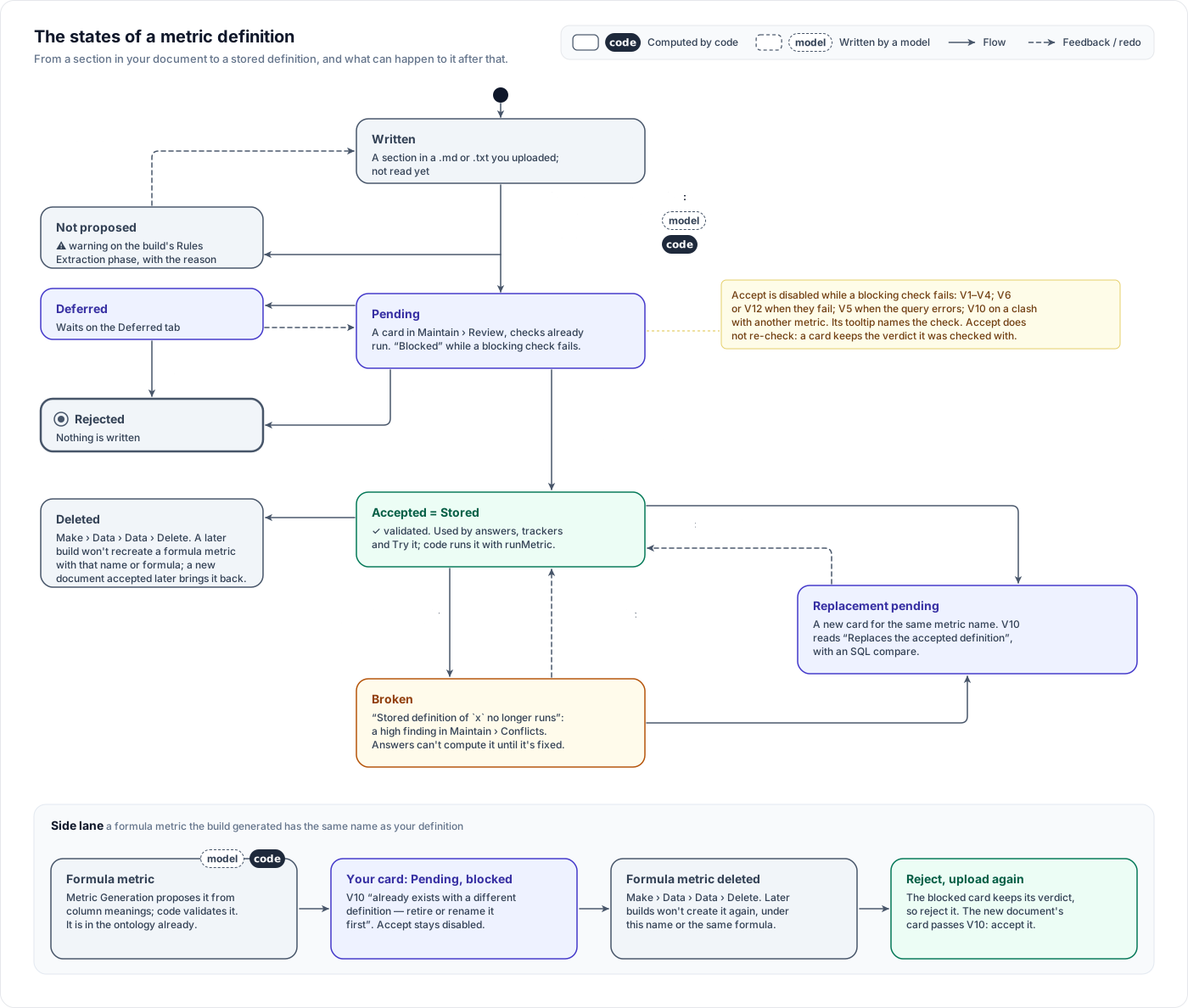
| State | What it means | How it gets there | What moves it on |
|---|---|---|---|
| Written | A section in a document you uploaded | Upload a .md or .txt on Sources › Upload | The next build's Rules Extraction reads it |
| Not proposed | The extractor could not use the section | A ⚠ line under rules_extraction on the Regenerate panel: "… not proposed — reason" | Nothing. Fix the section and upload it as a new document. |
| Pending | A card in Maintain › Review, with V1–V12 already run | Rules Extraction proposed it | Accept, Defer or Reject. If a blocking check failed, it is blocked: Accept stays disabled, because Accept uses the checks from when the document was read |
| Deferred | Parked | Defer | Accept or Reject from the Deferred list |
| Rejected | Discarded | Reject | End |
| Stored | In use by answers, trackers and Try it; "✓ validated" on its row | Accept | A build's dry run, a replacement, or Delete |
| Broken | Stored, but the warehouse no longer accepts the query. Answers cannot compute the metric from it | A build's dry run fails: HIGH finding "Stored definition of x no longer runs" in Maintain › Conflicts | Fix the table or upload a corrected document. The finding clears at the first build where it compiles again |
| Replacement pending | A new document defines the same metric | V10 Replaces the accepted definition, with SQL changed — compare | Accept updates the stored definition in place: family membership and links stay |
| Deleted | Removed from the ontology | Delete on Make › Data › Data › Metrics | A later build does not recreate a formula metric with that name or formula. Accepting a new document's definition of it brings it back |
A build never changes a stored definition. Only you do, by accepting a replacement or by deleting it.
Next
Your role and the lifecycle
What a data analyst owns in Tattva, how the layers fit together, and the path from an empty project to answers built on your definitions.
One metric, end to end
Follow Acme's net revenue from a BigQuery table to an answer and back, through every screen a data analyst touches.