Welcome to Tattva
A decision intelligence platform that turns your business data into defensible answers — with every recommendation cited and every decision logged.
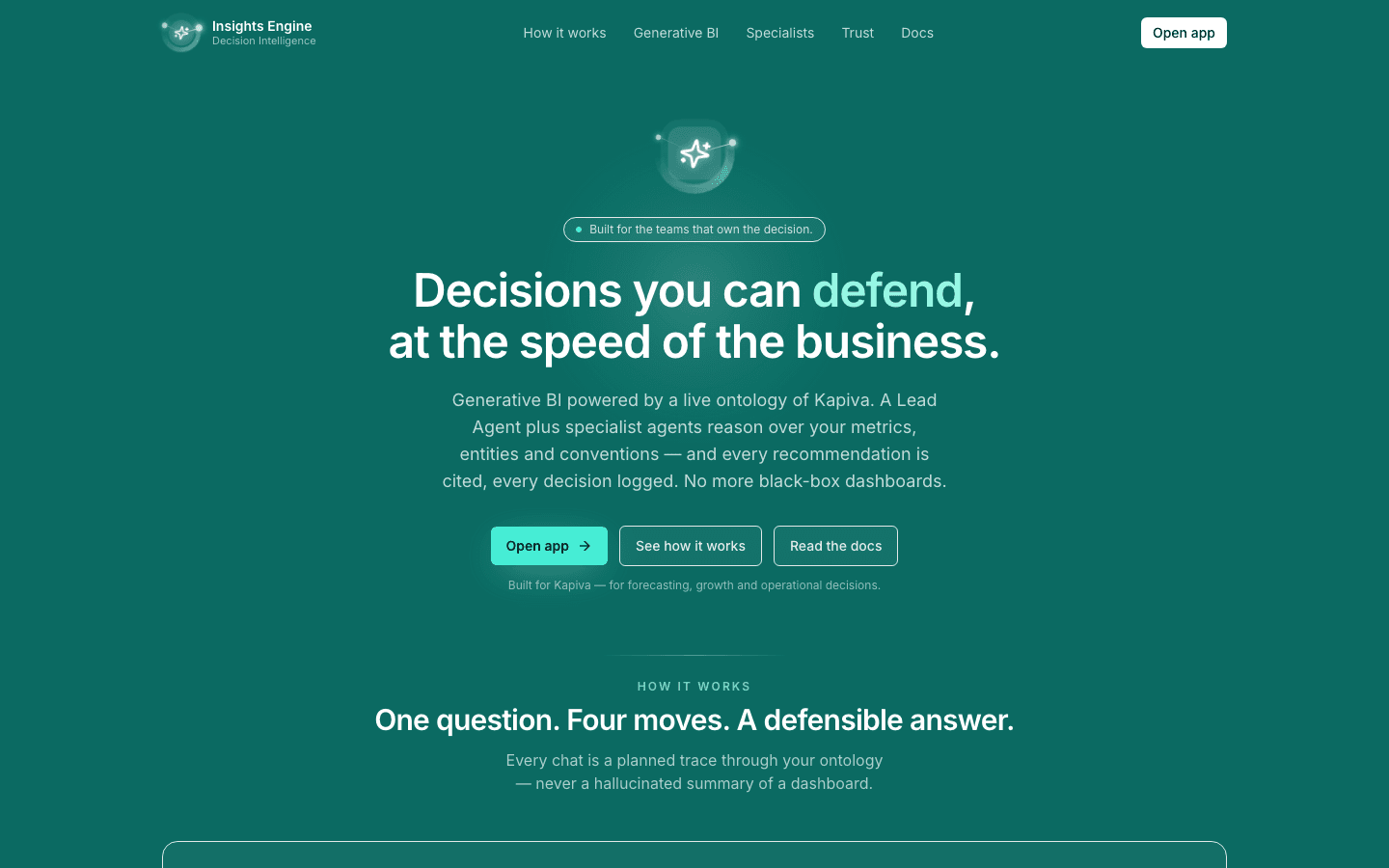
Tattva is a decision intelligence platform built for the teams that own the call. Instead of dashboards you have to read between the lines of, you ask a question in plain English and get a structured answer — with the data it came from, the reasoning behind it, and a record of the decision you made.
What you can do with it
- Ask questions of your data — sales, marketing, customer, product, growth or operations — and get back a focused answer, not a dashboard.
- Run specialist analyses — root-cause, forecast, attribution, optimization, correlation — on demand, with the same evidence trail.
- Track signals over time — turn any question into a recurring tracker that watches for drift, regressions, or threshold breaks.
- Ask forward-looking questions — what could go wrong, where the upside is, what to monitor before a launch.
- Defend the decision later — every answer is cited back to the rows, files and assumptions it was built from.
Who it's for
It's built for the people who have to make the call: growth leads, RevOps, CX heads, product leaders, founders and operators. You don't need to be technical — if you can write the question, the platform can do the work. Engineers and analysts get value too, but the day-one experience is designed for non-analysts.
How it's different from a dashboard
Dashboards show you numbers. Tattva reasons about them. It knows what each metric means in your business, where the data came from, what the conventions are (financial year, currency, segments), and which past decisions reference it. So when you ask "why did checkout conversion dip last week," you don't get a chart — you get the answer, the candidate causes ranked, and the rows that support each one.
How it's different from a chatbot
Chatbots make things up. Tattva doesn't speculate. Every claim it makes is anchored to a row, a file, a tracked metric or a documented convention — and when it can't ground something, it says so out loud and asks. You can always click into any sentence to see what it's built on.
Where to start
Quickstart
Sign up, create your first project, upload data, and ask a question — about five minutes end to end.
Core concepts
Learn what projects, sources, ontology, decision signs, skills and trackers are — and how they fit together.
Workflows
Step-by-step recipes for the things you'll do most: ask a question, review an answer, track a decision.
Reference
Glossary of terms, supported sources, and how suggested questions work.