Decision Signs
Your team's decision fingerprint — built from the decisions you actually make, not a personality quiz.
A Decision Sign is a portrait of how your team makes calls, computed from your actual decision history. It's not a personality test; it's a mirror.
The platform looks at the decisions you've logged, the hypotheses you've validated or invalidated, and the actions you've taken — and turns that into a profile with two parts: an archetype and a set of reasoning traits.
What's on the Decision Signs screen
Sidebar → Decision Signs.
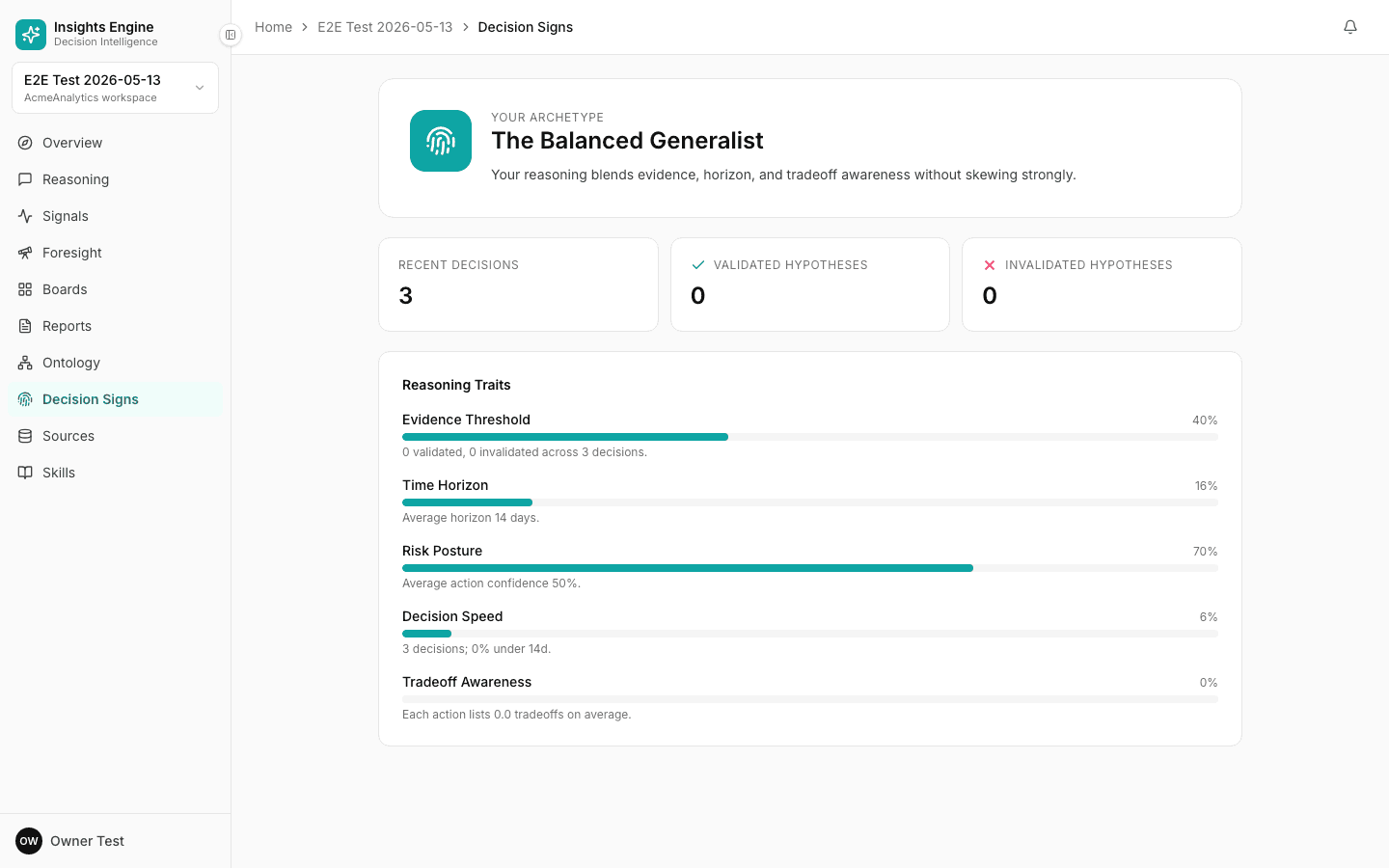
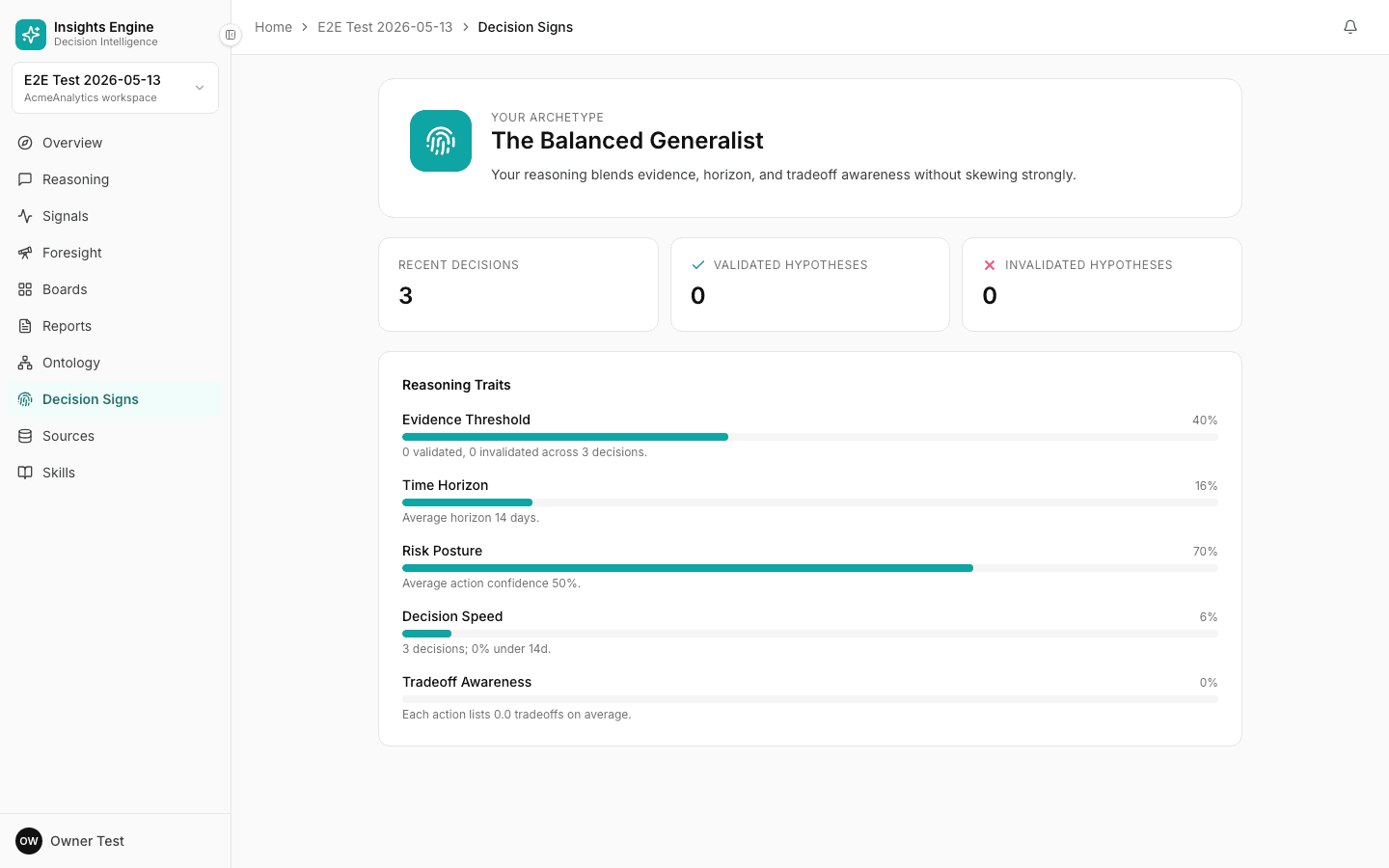
- Hero card "YOUR ARCHETYPE" — large heading with the current archetype (e.g. "The Balanced Generalist") and a one-line description of what it implies (e.g. "Your reasoning blends evidence, horizon, and tradeoff awareness without skewing strongly.").
- Stat strip — three cards:
- Recent Decisions (count)
- Validated Hypotheses (count, with ✓ icon)
- Invalidated Hypotheses (count, with ✗ icon)
- Reasoning Traits panel — five progress-bar rows, each with a percentage and a one-line evidence string. For example:
- Evidence Threshold — 40% — "0 validated, 0 invalidated across 14 decisions."
- Time Horizon — 16% — "Average horizon 14 days."
- Risk Posture — 70% — "Average action confidence 50%."
- Decision Speed — 28% — "14 decisions; 0% under two weeks."
- Tradeoff Awareness — 0% — (when no tradeoffs logged yet)
The whole page is computed from your decision history. With zero decisions logged it shows an empty state instead; as decisions accumulate (~20+), the archetype and traits stabilise into a real signal.
The five traits
Every project gets scored on five reasoning traits, each 0–1:
- Evidence Threshold — how often hypotheses are validated vs. invalidated. High = you don't act until the data is convincing.
- Time Horizon — average horizon (in days) of decisions made. High = you plan long.
- Risk Posture — inverse of average confidence. High = you take calls with less certainty.
- Decision Speed — recent decision volume and what % closed within two weeks. High = you ship calls fast.
- Tradeoff Awareness — average number of tradeoffs explicitly listed per decision action. High = you weigh alternatives.
These show up as a radar/spider chart and as individual cards with explanations.
The five archetypes
From the five traits, the platform picks one of five archetypes:
- The Calibrated Optimizer — high evidence threshold, moderate speed, balanced horizon. The team that runs the numbers before pulling the lever.
- The Patient Strategist — high time horizon, high tradeoff awareness. Plays the long game with explicit alternatives.
- The Iterative Operator — high decision speed, lower evidence threshold. Ships fast, learns fast.
- The Hypothesis Hunter — high evidence threshold + many hypotheses tracked. Treats every call as an experiment.
- The Balanced Generalist — no extreme trait. Mixed mode.
The archetype changes as your decision history grows. Early on, the platform shows an empty state — there isn't enough signal yet.
Why this exists
Three reasons:
- Self-awareness. Knowing "we're a Patient Strategist team" helps you spot when a call doesn't fit your usual pattern. That's often a sign to slow down or get a second opinion.
- Communication. A new hire can see the team's decision style in one screen, instead of inferring it from a hundred Slack threads.
- Calibration. If your traits show low confidence but high speed, the platform can suggest tighter evidence in future answers.
What feeds it
The Decision Signs page reads directly from:
- Decisions you've logged (from a Reasoning answer's "Save as decision" button, or written directly).
- Hypotheses you've validated or invalidated.
- Decision actions — the steps you committed to as part of a decision.
The more decisions you log, the more accurate the sign becomes. Don't worry about being prolific — twenty real decisions over a few months is plenty.
Where to find it
Sidebar → Decision Signs.
Tips
- Log the decision even if it was obvious. The pattern matters more than any single call.
- Mark hypotheses as validated or invalidated. That's what feeds Evidence Threshold and the Hypothesis Hunter archetype.
- Write down the tradeoffs. Even a one-line list per action sharpens Tradeoff Awareness over time.